Sports and school events produce thousands of photos. How can you share them while respecting image rights? A secure gallery with facial recognition offers a practical solution.
Are you organizing a mountain trail race, a school competition, or a sports tournament? You are probably wondering how to share the photos. How can you distribute these precious memories without publicly exposing hundreds of participants?
Every event organizer faces this issue. Take the concrete example of a trail race with 500 runners. The photographers stationed along the course produce 3,000 photos. What should you do with all those images?
Traditionally, there are two options:
- Publish all the photos online, accessible to everyone
- Send the photos individually by email (time-consuming and complicated)
But with stronger image rights protections and the enforcement of the GDPR, both approaches are showing their limits. The first exposes people without their consent, and the second becomes unmanageable as soon as an event has more than a few dozen participants.
A secure gallery with facial recognition: how does it work?
This technology addresses exactly this challenge. The process respects privacy:
- The organizer creates a private, secure gallery
- Each participant receives a unique QR code
- By scanning this code, the participant takes a reference selfie
- The system instantly shows them all their photos from the event
The advantage? No global database is created. The mathematical face templates remain linked solely to that specific gallery. When the event is over and the gallery is deleted, all biometric data is permanently erased.
Why does this approach make a difference?
Because it solves concrete problems you are probably facing:
For participants: A trail runner does not necessarily want a photo of themselves at the finish line, exhausted and drenched in sweat, to be publicly visible on social media. With this system, they control what they see and what they share.
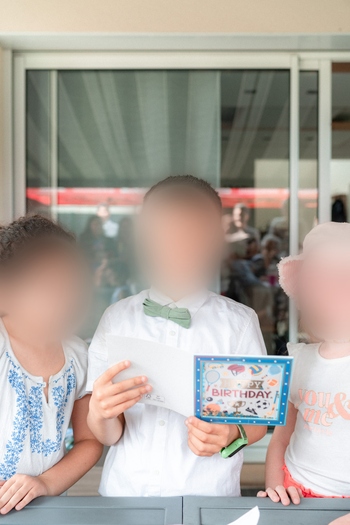
For school organizers: A school cannot legally distribute photos of children without explicit parental consent. A private gallery avoids this unwanted exposure while still allowing families to retrieve their memories.
For associations: No more complex paperwork to collect everyone's consent. Participants choose to access their own photos, which amounts to implicit consent to viewing them.
Here, facial recognition becomes a tool that serves privacy, not surveillance. It makes privacy easier to respect rather than harder.
Many uses, tested in the field
This solution adapts to a wide range of settings:
- Trail and nature races: Runners find their photos from the start, the finish, and the checkpoints
- CrossFit competitions: Each athlete accesses their own performance moments without seeing anyone else's
- Sports tournaments: Teams retrieve their action and podium photos
- School events: Families view photos of their children at shows or on field trips
- Association celebrations: Members access their memories of the event
This technology strikes a balance between sharing and protection. In a world where our personal data is often used without our knowledge, it offers a transparent approach: you control what you see, and you decide what you download.
For you as an organizer, it is a way to respect image rights without giving up on sharing the precious moments that give your events their meaning.